



















































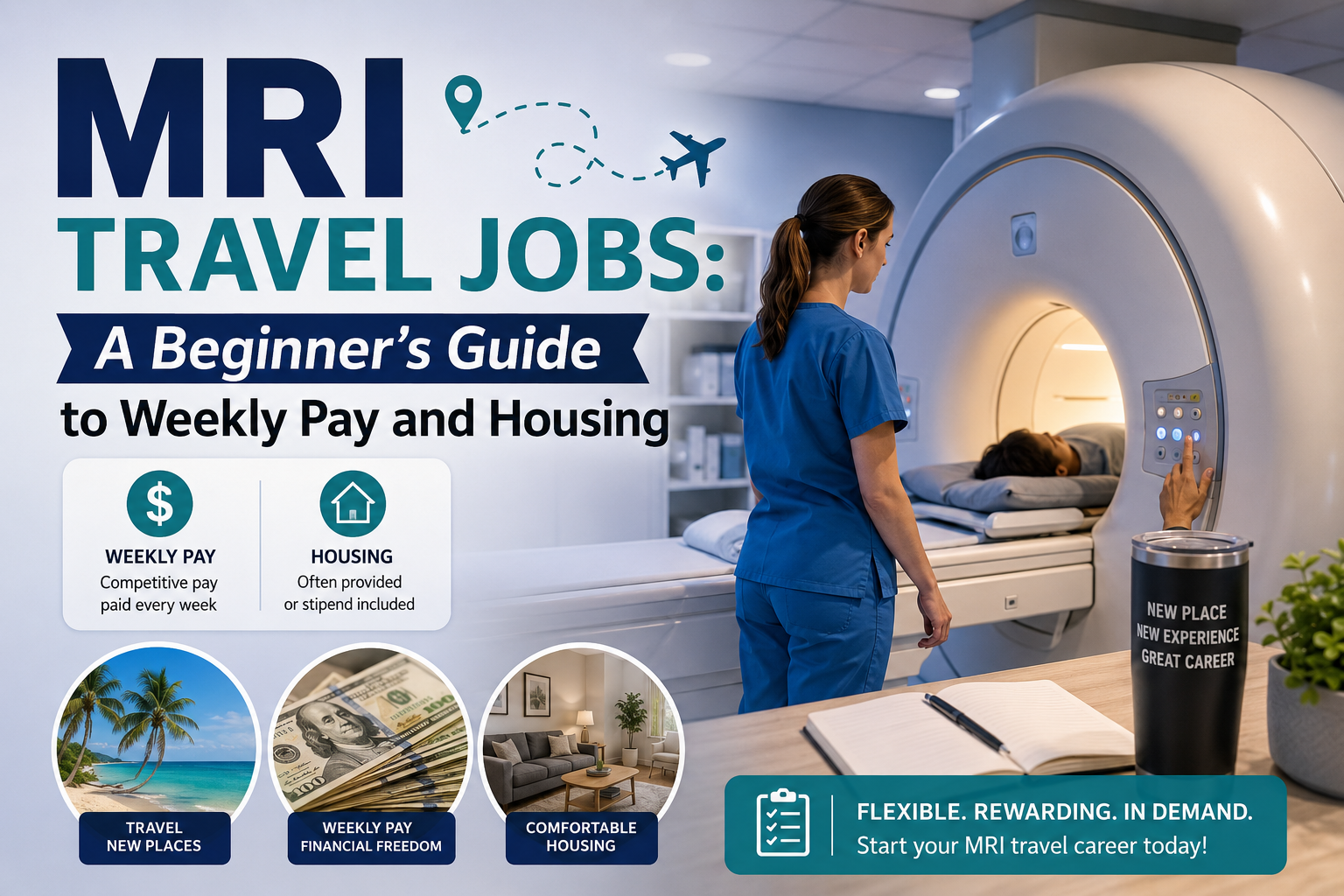

MRI Travel Jobs: A Beginner’s Guide to Weekly Pay and Housing is a useful starting point for MRI technologists who want to combine healthcare with travel and flexible contract work. Travel MRI technologists work at hospitals, imaging centers, and other healthcare facilities that need temporary imaging professionals. These assignments can provide competitive compensation while allowing qualified technologists to experience different cities and healthcare environments.
The financial side of travel work is one of its biggest attractions, but the advertised weekly amount is only part of the picture. A travel package may combine taxable wages with housing or other expense reimbursements. Housing can also be arranged by the staffing agency or provided as a stipend, depending on the assignment and eligibility. Understanding these details before accepting a contract can help beginners make smarter career decisions.
What Are MRI Travel Jobs?
MRI travel jobs are temporary positions for qualified magnetic resonance imaging technologists who work away from their permanent residence. Healthcare facilities use traveling professionals when they have staffing shortages, increased patient demand, seasonal needs, or difficulty finding permanent employees. Assignments are commonly structured as short-term contracts, allowing technologists to move between locations after completing an assignment.
Many current listings use contracts of around 13 weeks, although assignment lengths can vary. Aya Healthcare, for example, states that most travel assignments are 13 weeks, while some can range from 8 to 26 weeks or longer. Extensions may also be possible when both the technologist and facility agree.
Travel work can be particularly attractive to experienced MRI technologists who enjoy variety. Instead of remaining in one facility, travelers can work with different teams, learn different workflows, and gain exposure to various MRI systems and patient populations. This experience may strengthen a professional résumé while providing opportunities to explore new parts of the country.
How Much Can an MRI Technologist Earn Weekly?
Weekly compensation is one of the most searched aspects of travel imaging careers. Current job-market data shows that pay can vary substantially depending on location, experience, schedule, specialty requirements, and demand. Aya Healthcare reported an average weekly figure of $2,532 for its travel MRI technologist openings based on 148 jobs with schedules of at least 36 hours per week as of August 29, 2026. Its listed range was approximately $1,319 to $3,741 per week.
AMN Healthcare’s current listings also demonstrate the wide variation between assignments. Its available MRI technology positions showed weekly compensation ranging from about $1,597 to $4,309, with an average around $2,491 per week at the time of its latest listing update. Individual contracts can therefore look very different even when the professionals have similar job titles.
It is important to remember that an advertised weekly package is not necessarily the same as taxable salary. Some packages combine taxable hourly wages with tax-free expense reimbursements or stipends for eligible travelers. Aya specifically notes that its displayed travel MRI compensation includes taxable wages and tax-free expense reimbursements.
Understanding Weekly Pay Packages
A travel compensation package can contain several components. The taxable portion generally comes from the hourly wage paid for hours worked. Other portions may include housing assistance, meals and incidentals, travel reimbursement, or other eligible expense reimbursements. The exact structure depends on the staffing agency, assignment, location, and the traveler’s circumstances.
Because two assignments can advertise similar weekly totals while having very different pay structures, beginners should examine the complete package instead of choosing the highest headline number. Ask how much is taxable, how many hours are guaranteed, what overtime rules apply, whether housing is included, and whether travel reimbursement is separate from the quoted weekly amount.
Weekly payroll can also make budgeting easier for travelers. Aya states that its allied health travelers are paid weekly through direct deposit while payroll representatives verify hours. However, payment schedules and policies can differ between staffing agencies, so it is wise to confirm the details before signing a contract.
Housing Options for Travel MRI Technologists
Housing is one of the biggest benefits associated with eligible travel assignments. Instead of finding and paying for temporary accommodation entirely on your own, you may have the option to receive agency-arranged housing or a housing stipend. Aya, for example, says eligible MRI travelers can choose company-arranged housing or a housing stipend and find accommodation independently.
Agency-provided housing can be convenient for beginners because the staffing company handles much of the arrangement. This may reduce the stress of searching for an apartment in an unfamiliar city. On the other hand, a stipend can provide greater flexibility because you can search for housing that matches your preferred location, lifestyle, and budget.
Before choosing a housing option, compare the value of the stipend with actual rental prices in the assignment area. A high-cost city may require careful budgeting even when the housing allowance appears generous. Travelers should also consider parking, utilities, transportation, deposits, furnishings, and commuting distance before deciding where to live.
Qualifications for Travel MRI Positions
Travel MRI technologists generally need professional education, relevant clinical experience, and appropriate certification or credentials. Specific requirements vary between facilities and agencies. Current Aya listings, for example, show assignments requiring credentials such as ARRT MR or ARMRIT, BLS certification, and at least one year of experience for certain positions.
Experience is especially important because travelers are expected to adapt quickly to unfamiliar facilities. A new traveler may need to operate different MRI systems, follow new protocols, work with different patient populations, and integrate into a team with limited orientation time. Strong technical skills and confidence can make the transition much easier.
Licensing requirements also depend on the state and facility. Some locations may require additional state-specific credentials or documentation. Before applying, verify the licensing requirements for every state where you are considering an assignment and ask your recruiter which documents are needed for credentialing.
Choosing the Right Assignment
The highest-paying contract is not always the best contract. Location, schedule, facility type, commute, housing costs, guaranteed hours, cancellation terms, and overall working conditions can have a major effect on your experience. A slightly lower weekly package may provide greater financial value if housing is inexpensive and the schedule is convenient.
Location flexibility can also improve earning potential. Current travel-job data shows high-paying MRI assignments in several different states and cities. Aya’s listings have recently included opportunities paying above $3,000 per week in locations such as California and Vermont, while AMN has listed high-paying positions in California and other states.
Consider the type of MRI experience you want to develop as well. Some assignments may involve outpatient imaging, while others can include hospital, emergency, trauma, or inpatient work. Choosing contracts that strengthen your professional skills may be more valuable for your long-term career than focusing only on the immediate paycheck.
How to Get Started With Travel MRI Work
The first step is to prepare a professional résumé that clearly presents your MRI experience, certifications, clinical skills, and recent employment history. Gather copies of your credentials, identification documents, references, immunization records, and other materials commonly required during healthcare credentialing. Having your paperwork organized can help reduce delays when a suitable assignment becomes available.
Next, research reputable staffing agencies and compare their contracts carefully. Ask recruiters about weekly compensation, guaranteed hours, overtime, housing, travel reimbursement, insurance, retirement benefits, licensing assistance, and contract cancellation policies. AMN, for example, advertises weekly pay, housing options, travel reimbursements, and benefits for its imaging and radiology travelers.
Once you find an attractive assignment, review the written contract carefully before accepting it. Make sure the compensation package matches what the recruiter explained verbally. Pay attention to start and end dates, scheduled hours, housing arrangements, reimbursement policies, and any conditions that could affect your earnings.
Benefits and Challenges of Travel MRI Work
One major advantage of travel work is professional flexibility. Technologists can explore different regions, experience various healthcare environments, and potentially earn more than they would in some permanent positions. Travel assignments can also help professionals expand their network and develop adaptable technical skills.
However, travel work comes with challenges. Moving every few months can be tiring, housing arrangements can require planning, and adapting to unfamiliar workplaces may be stressful. Travelers may also spend time away from family and friends. Understanding these realities before accepting an assignment helps ensure that the lifestyle matches your personal and professional goals.
Benefits can vary by agency and contract. Some agencies provide medical, dental, and vision insurance, retirement options, sick time, continuing education, licensing assistance, and other support. For example, Aya currently advertises medical, dental, vision, and life insurance beginning on the first day of an eligible assignment, along with other traveler benefits.
Conclusion
MRI travel work can be an attractive career path for qualified technologists who want competitive compensation, professional variety, and the opportunity to experience different parts of the country. Current listings show that weekly packages can reach well above $3,000 in some markets, while average compensation varies by agency, location, schedule, and assignment requirements. Housing may also be provided through company-arranged accommodation or a stipend for eligible travelers.
For beginners, the smartest approach is to look beyond the advertised weekly number. Compare taxable wages, reimbursements, housing, guaranteed hours, benefits, travel costs, and contract conditions before making a decision. With the right credentials, relevant experience, careful planning, and a reliable staffing agency, travel MRI work can become a rewarding way to build a flexible healthcare career while exploring new destinations.
FAQs
What are MRI travel jobs?
They are temporary positions for qualified MRI technologists who work at healthcare facilities away from their permanent home location.
How much do travel MRI technologists make per week?
Current listings vary considerably. Recent data from Aya Healthcare showed an average of about $2,532 per week, while AMN’s listings showed an average around $2,491. Actual packages depend on the assignment.
Do travel MRI technologists get housing?
Eligible travelers may receive agency-arranged housing or choose a housing stipend and arrange accommodation themselves, depending on the contract.
How long are typical travel assignments?
Many assignments last approximately 13 weeks, although contracts can be shorter or longer depending on facility requirements.
Do I need experience before becoming a travel MRI technologist?
Most travel positions require recent specialty experience. Some current listings specify at least one year of experience, although requirements vary by employer and assignment.
Is travel MRI pay taxable?
Not necessarily all of the advertised package. Some compensation may consist of taxable wages and eligible tax-free expense reimbursements. Your specific contract and tax circumstances determine how the package is treated.
Can MRI travelers receive health insurance?
Many staffing agencies offer benefits. For example, Aya currently advertises medical, dental, vision, and life insurance for eligible travelers.
How can I find the best-paying assignment?
Compare multiple contracts rather than focusing only on the headline weekly amount. Consider the taxable wage, housing, guaranteed hours, location, schedule, reimbursements, benefits, and total living costs before choosing an assignment.


[…] is another potential advantage. Modular or integrated systems can sometimes be adapted as an organization’s needs change. […]