



















































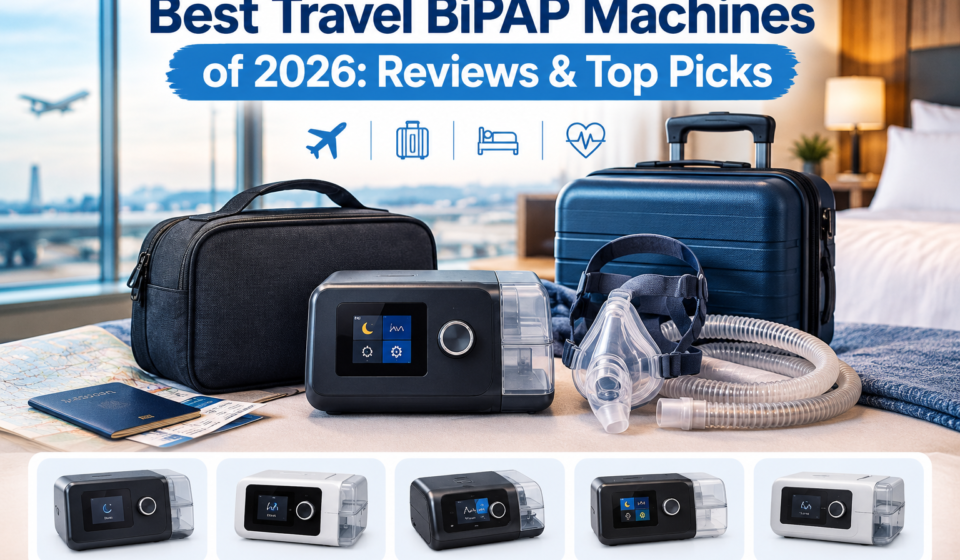

Traveling with a BiPAP machine can feel difficult at first. A regular machine, mask, tubing, power supply, humidifier, and accessories can take up valuable luggage space. However, the right setup can make travel much easier. Modern bilevel devices offer useful comfort features, compact designs, data tracking, and flexible power options.
The best travel BiPAP machine is not always the smallest machine available. It needs to match your prescribed therapy while also fitting your travel routine. Weight, size, power requirements, humidification, noise, carrying cases, and battery support all matter. This guide looks at some of the strongest BiPAP options to consider in 2026 and explains what makes each one useful for travel.
Important: BiPAP and BPAP machines are prescription medical devices. Your doctor or qualified sleep professional should determine which therapy mode and pressure settings are appropriate for you. Do not change prescription settings simply to make a machine more convenient for travel.
What Is a BiPAP Machine?
BiPAP, also called bilevel positive airway pressure or BPAP, uses different pressure levels when you breathe in and breathe out. The higher inspiratory pressure and lower expiratory pressure can make bilevel therapy different from standard CPAP therapy. The FDA describes BiPAP machines as devices that provide varying pressure through the airway and notes that they can be prescribed for conditions including obstructive sleep apnea.
That difference is important when choosing a machine for travel. A tiny travel CPAP is not automatically a suitable replacement for a prescribed BiPAP device. Many compact travel machines are designed specifically for CPAP or AutoCPAP rather than bilevel therapy. For that reason, travelers who need bilevel therapy often need to prioritize a compact full-size device rather than simply buying the smallest PAP machine they can find.
What Makes a Good Travel BiPAP Machine?
Portability is the first thing most travelers consider. A machine that is easy to pack can make airports, hotels, road trips, and longer vacations less stressful. However, size should not be considered by itself. A lightweight device that lacks the therapy mode you need is not a useful travel machine.
Power flexibility is another major consideration. You may need access to standard electrical outlets, a compatible battery, or a suitable DC power solution depending on your trip. ResMed recommends discussing portable power options with your equipment provider and notes that certain converters can allow compatible devices to work from suitable vehicle power sources.
Humidification also matters. Some travelers prefer heated humidification because it can make therapy more comfortable. Others prefer to travel without a humidifier because it reduces bulk and simplifies packing. Your personal therapy needs should come first, but a removable or integrated humidifier can make a significant difference to your travel setup.
ResMed AirCurve 11: Best Overall Modern Travel BiPAP Choice
The ResMed AirCurve 11 is one of the most attractive choices for travelers who need a modern bilevel device. It combines bilevel therapy with a relatively streamlined design, a touchscreen interface, integrated humidification, and digital features. The AirCurve 11 VAuto is designed for people with obstructive sleep apnea who benefit from greater pressure support, while the AirCurve 11 ASV is intended for specific breathing disorders and has different clinical indications.
One of the biggest advantages for frequent travelers is the overall user experience. The machine includes access to ResMed’s myAir platform, while Personal Therapy Assistant can provide setup guidance and troubleshooting support. This can be useful when moving between home, hotels, and other environments.
The AirCurve 11 is not a tiny travel PAP in the same way as some CPAP-only travel machines. That distinction is important. It is better viewed as a portable, full-featured BiPAP machine rather than a miniature travel device. For people who need bilevel therapy and want current technology, however, that larger footprint may be a reasonable trade-off.
ResMed AirCurve 10: A Strong Choice for Travelers Seeking Value
The AirCurve 10 remains worth considering in 2026, particularly for travelers who want a proven bilevel platform without necessarily needing the newest design. The AirCurve 10 family includes S, VAuto, and ASV models, with different therapy purposes. ResMed also provides myAir support for compatible devices.
The AirCurve 10 VAuto is particularly relevant for users prescribed auto-adjusting bilevel therapy for obstructive sleep apnea. It provides separate inhalation and exhalation pressure control and includes features designed to support breathing comfort. The device also supports remote therapy data management through compatible ResMed systems.
For travel, the AirCurve 10 has one notable advantage: its specifications and accessories are well established. ResMed documentation lists the device and humidifier at about 1.25 kilograms, with dimensions of approximately 116 by 255 by 150 millimeters. The device is also documented for aircraft use under applicable requirements.
React Health Luna G3 BiLevel 25A: Best for a Compact Footprint
The React Health Luna G3 BiLevel 25A is another strong option for people looking for a relatively compact bilevel machine. The manufacturer lists dimensions of 10.4 by 5.7 by 4.5 inches and a weight of 3.75 pounds. It also includes a carry bag, heated tubing, an AC/DC power cord, and reusable filters.
The G3 25A provides several useful travel-oriented features. It has an integrated humidifier, a full-color display, a single control dial, and a pressure range of 4 to 25 cmH₂O. React Health also lists a sound pressure level below 26 dBA under its specified testing conditions.
That combination makes the Luna G3 appealing for travelers who want a traditional bilevel machine with a relatively manageable footprint. It is still much larger than a dedicated travel CPAP, but that is expected because true bilevel therapy requires a different type of device. Its included carry bag is also useful for keeping the machine and basic accessories together.
Luna G3 BiLevel ST 30 Vt: Best for More Advanced Therapy Needs
The Luna G3 BiLevel ST 30 Vt is designed for users whose prescribed therapy requires more advanced bilevel functionality. React Health lists CPAP, S, T, and S/T modes, along with ventilation pressure capabilities and a backup breathing rate. It has the same 10.4 by 5.7 by 4.5-inch dimensions and 3.75-pound weight as the G3 25A.
This model can be particularly relevant when a person’s prescription calls for a backup rate or additional ventilatory support. However, those features also make it especially important not to choose the device based only on portability. Advanced therapy modes should be selected by a qualified clinician according to the individual’s condition and prescription.
For travel, the machine offers integrated humidification, heated tubing, a carry case, SD storage, and connectivity options. These features can help users maintain their normal therapy routine while away from home. Still, travelers should confirm their exact settings and equipment requirements with their healthcare provider before leaving.
Philips DreamStation BiPAP: What Travelers Should Know in 2026
Philips has several DreamStation-based bilevel and noninvasive ventilation products, including DreamStation BiPAP S/T and DreamStation BiPAP AVAPS models. Their specifications include multiple therapy modes, heated humidification options, data storage, and pressure ranges that vary by model.
However, there is an important consideration for buyers in the United States. Philips currently states that Respironics will continue servicing existing sleep and respiratory care devices and supplying certain accessories and replacement parts, but it will not resume selling new CPAP or BiPAP sleep therapy devices in the U.S. until agreed with the FDA.
Because of that situation, Philips DreamStation models should not automatically be treated as the first choice for someone shopping for a new travel BiPAP machine in the U.S. Existing users may still need support for their current equipment, while new buyers should verify availability, regulatory status, recalls, and support in their own country before purchasing any Philips device.
Why Tiny Travel PAP Machines Are Not Always BiPAP Machines
This is one of the most important points in any travel BiPAP buying guide. Small travel PAP machines are widely available, but many are designed for CPAP rather than bilevel therapy. For example, React Health’s TravelPAP weighs only 14.1 ounces and measures 6.26 by 2.60 by 2.83 inches, but its listed modes are CPAP and AutoCPAP.
That makes it an impressive portable PAP machine, but it does not mean it is an appropriate substitute for a prescribed BiPAP device. The same principle applies to other compact travel machines. Before buying, check the exact therapy modes rather than relying on words such as “travel,” “portable,” or “lightweight.”
For someone who needs bilevel therapy, a slightly heavier machine may be the better travel choice. Maintaining the prescribed therapy is more important than saving a pound of luggage space. A travel-friendly setup should make your therapy easier to continue, not replace the therapy your clinician selected.
Battery Power for Travel BiPAP Machines
Battery planning becomes especially important when traveling somewhere without reliable electrical outlets. Camping trips, long road journeys, cruises, remote hotels, and unexpected power outages can all create situations where standard wall power is unavailable.
Battery compatibility depends heavily on the machine and power requirements. You should never assume that a generic power bank can safely operate a BiPAP device. Check the manufacturer’s approved power options and calculate your expected usage based on your device, pressure, humidifier, heated tubing, and other accessories.
Humidification can have a major effect on battery demand. A heated humidifier generally consumes more power than running the machine without heated humidification. If you are planning to rely on battery power, ask your equipment provider which accessories can be used and what runtime you can realistically expect.
Flying With a Travel BiPAP Machine
Air travel is one of the most common reasons people search for a portable BiPAP setup. The best approach is to keep the machine, power supply, mask, tubing, and important accessories together in a dedicated medical-equipment travel bag.
Do not pack your machine in checked luggage if you can reasonably avoid it. Keeping essential therapy equipment with you reduces the risk of loss or damage. Before flying internationally, also check the electrical requirements at your destination. A machine that supports a broad input voltage range can simplify international travel, but you may still need a suitable plug adapter.
ResMed provides travel guidance stating that its compatible therapy devices can work with certain aircraft power arrangements and that users should check with their equipment provider regarding batteries and converters. Always confirm the rules of your specific airline before your trip because aircraft policies and onboard power availability can vary.
Traveling Internationally With a BiPAP Machine
International travel introduces a few extra considerations. Power outlets differ between countries, so a plug adapter may be necessary. However, a plug adapter changes the physical connection and is not necessarily a voltage converter. Check the electrical specifications of your exact machine before connecting it to a foreign outlet.
Climate can also affect your experience. A humid destination may make heated humidification feel different from the dry air of an airplane cabin or a cold hotel room. High-altitude travel can also require planning. ResMed notes that users traveling to high elevations should check with their equipment provider and that some devices compensate automatically while certain lightweight devices may require adjustment.
Pack spare filters, necessary mask components, tubing accessories, and any other small replacement items you normally use. A missing connector or damaged tube can become a much bigger problem when you are far from home. Keeping a copy of your prescription and equipment information can also make international travel easier.
How to Choose the Best Travel BiPAP Machine
The first question is not “Which machine is smallest?” It is “Which therapy does my prescription require?” Once that is clear, you can compare portability, weight, dimensions, humidification, power options, noise, data features, accessories, and support.
Next, think about how you actually travel. Someone who stays in hotels may care most about compact packing and quiet operation. A road-trip traveler may place greater importance on DC power or battery compatibility. A camper may prioritize long battery runtime. Someone who travels internationally may focus on voltage compatibility and service availability.
Finally, consider support after purchase. A medical device is different from an ordinary travel gadget. Replacement parts, masks, tubing, filters, batteries, and professional support can matter just as much as the machine itself. Choosing a model with reliable local or international support can save considerable stress later.
Best Travel BiPAP Machines of 2026: Final Picks
The ResMed AirCurve 11 stands out as a strong overall choice for travelers who want a current, feature-rich bilevel platform. Its touchscreen, integrated humidification, connected features, and modern design make it attractive for people who want technology and convenience.
The ResMed AirCurve 10 remains a sensible option for users who value an established platform and familiar accessories. Meanwhile, the Luna G3 BiLevel 25A provides a compact full-size bilevel design with integrated humidification and a useful travel case. For users with more advanced prescribed needs, the Luna G3 BiLevel ST 30 Vt offers additional therapy modes and backup-rate capabilities.
There is no single best travel BiPAP machine for everyone. The correct choice depends on your prescribed therapy and travel habits. A smaller device may be easier to pack, while a larger model may provide the exact features your treatment requires. The smartest approach is to choose the right medical device first and then optimize the travel setup around it.
Conclusion
The best travel BiPAP machines of 2026 make it easier to maintain prescribed therapy while you are away from home. ResMed’s AirCurve 11, AirCurve 10, and React Health’s Luna G3 BiLevel models are among the options worth researching. Each has different strengths, so the right choice depends on your therapy requirements, portability needs, power setup, and preferred comfort features.
Remember that portability should never come at the expense of appropriate therapy. A compact CPAP is not automatically a replacement for a BiPAP machine. Before purchasing, speak with your doctor or medical equipment provider, confirm the exact therapy mode you need, and check power and accessory compatibility. With the right preparation, traveling with a BiPAP machine can become a normal part of your routine rather than a major obstacle.

[…] Seat October 6, 2026 Compact & Capable: Top 10 Travel Brushes for Every Hair Type October 6, 2026 Best Travel BiPAP Machines of 2026: Reviews & Top Picks October 6, […]