



















































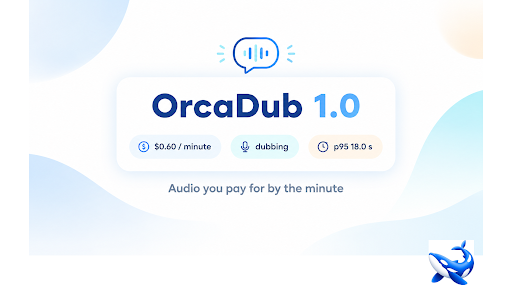

On OrcaRouter we host the OrcaDub 1.0 model — our audio-dubbing model, shipped on July 27, 2026, priced at $0.60 per minute of audio produced, with no context window and no token-based rate card — audio models are not priced per token, and this one is billed by the minute instead. In production its p95 time-to-first-response is 18.00 seconds and its directory entry records no p50 figure and no weekly token volume, because the units of this card are minutes of audio, not tokens. It is our own product, so no independent third-party score exists to cite; the production record above is the evidence, with the live telemetry on the linked page.
A model you pay for by the minute, in a market that prices most audio by the second — the billing unit is the headline, and this article is about what that unit says about the job the card is built for.
Why a minute, not a token
The billing unit is the design statement. Audio work does not have tokens the way text does — a second of speech is a second of speech, and the honest unit for dubbing is the minute of output a job actually produces. OrcaDub 1.0 is priced at $0.60 per minute of audio, which means a five-minute dubbed clip costs $3.00 and a ten-minute one costs $6.00, with no input meter and no hidden output multiplier. The arithmetic is exactly as legible as it looks: the price is a function of what you ship, not of what the model happens to generate along the way.
That unit also sets the card apart from the fleet’s per-token and per-second pricing. A per-minute rate is predictable for a workflow that always knows the runtime it needs — a training video of known length, a podcast episode, a localization pass over a fixed script — and predictability is the point. The p95 first-response of 18.00 seconds is the honest counterpart: this is not an interactive card, it is a batch-and-render card, and the article reports the p95 figure plainly because the directory entry records no p50.
The audio row of the lineup
| card | kind | pricing unit | rate | latency | 7-day usage |
| OrcaDub 1.0 | dubbing | per minute | $0.60 / min | p95 18.00 s | not listed |
| MiniMax-H3 | speech | per second | $0.08 / s | p50 406 ms | 100.6K |
| Kling 3.0 Turbo | video | per request | $0.11 / req | not listed | not listed |
Pricing units, rates and latency figures are from the linked pages on the platform; all three rows are media cards, and the rows are listed to show how differently the media lineup is billed rather than to compare like for like. The table is the fleet’s media row, and it makes OrcaDub 1.0’s position precise: the dubbing card is billed by the minute, the speech card by the second, and the video card by the request — three media workloads, three different units, each matched to how the job is bought. A dubbing pass has a runtime you know in advance, and the per-minute rate is what a workflow that plans around runtime wants.
What a dubbing card is for
The workload that fits OrcaDub 1.0 is the workload with a known runtime: localizing a training course into another language, dubbing a product explainer, adding a voice pass to a fixed script. Each job has a length the team knows before the render starts, which is exactly why the per-minute price works — a training course of forty minutes costs $24.00, and the budget is set before the first second of audio is produced. The p95 first-response of 18 seconds says the card is built for queued jobs, not live conversation: submit, wait for the render, take the finished audio.
The honest boundary is the one the record itself sets. Because OrcaDub 1.0 is our own product, its evidence is our own production telemetry, and no independent third-party score exists to cite. The record shows a card priced and shaped for batch dubbing — per-minute billing, a p95 that assumes a render queue, and no token meter because tokens are not the unit the work is measured in. For a media workflow that knows its runtime, that is precisely the profile to plan against.
Billing the way the job is bought
The per-minute unit does more than price the job — it changes how a team can budget it. A text model’s bill varies with prompt length and generation size; a per-second speech model’s bill varies with how much the model chooses to say. OrcaDub 1.0’s bill varies with exactly one thing: the runtime the team already knows. That is the card’s whole economic argument, and it is why the billing unit is the headline rather than a footnote.
The article’s discipline for our own product is to report what the record does and does not prove. The record proves that OrcaDub 1.0 runs dubbing workloads with a p95 first-response of 18.00 seconds at a $0.60-per-minute list price, measured on our own endpoint. It does not provide an independent benchmark — none exists to cite for this card — and it does not pretend the card is interactive, because the p95 figure says it is not. For a team shipping known-length audio, the trade is a clean one: a predictable per-minute bill in exchange for a queued render, with the live telemetry on the linked page.
The units are worth translating before the verdict, because the two audio meters read the same job differently. OrcaDub 1.0’s $0.60 per minute is $0.01 per second; the speech card’s $0.08 per second is $4.80 per minute — for continuous output, the same minute of audio costs eight times as much on the per-second meter as on the per-minute one. The difference is not a discount, it is a fit: interactive speech pays per instant of speech the model produces, while dubbing pays per minute of finished audio the job ships, and a team that knows its runtime is buying the meter that matches the way it plans. The per-minute rate is not cheaper for every job — it is cheaper for exactly the jobs dubbing does, and that is the point.
The takeaway
OrcaDub 1.0 is our audio-dubbing model: $0.60 per minute of audio produced, no context window and no token-based rate card, a p95 first-response of 18.00 seconds, and no p50 or weekly-token figure because the card’s units are minutes of audio, not tokens. It is our own product, so no independent score exists to cite, and the production record is the evidence. That record says a dubbing card can be billed the way the job is bought — by the minute a team already knows its runtime in — and rendered through a queue at a predictable price. If your workflow ships known-length audio, this is the card — live at list price, with the telemetry on the linked page.
