




















































Traveling to South Africa means preparing for more than flights, accommodation, and sightseeing. One small item that can make a major difference is a South Africa travel adapter, especially if you are bringing a phone, laptop, camera, tablet, electric shaver, or other personal electronics. South Africa uses a distinctive plug system, so travelers from many countries may find that their usual chargers do not fit local wall sockets.
Understanding the local plug type, voltage, and frequency can help you avoid charging problems during your trip. An adapter changes the shape of a plug so it can connect to a different socket, while a voltage converter has a different purpose. Knowing the difference is particularly important when traveling with appliances that may not support South Africa’s electrical standards.
This guide explains what travelers need to know about South African sockets, charging equipment, voltage compatibility, and practical packing. Whether you are visiting Cape Town, Johannesburg, Durban, Pretoria, or smaller destinations, a little preparation can make keeping your devices powered much easier.
Why You Need a South Africa Travel Adapter
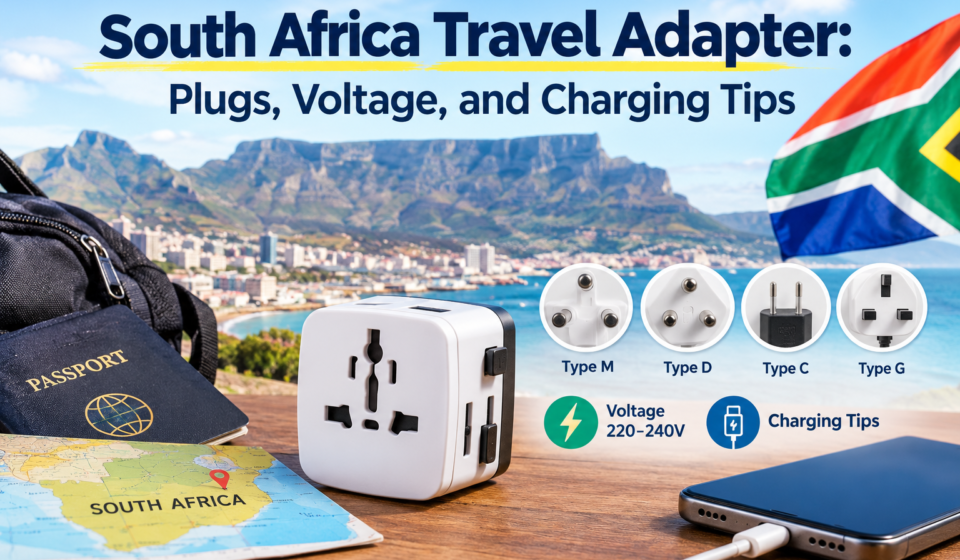
A South Africa travel adapter is useful because the country’s electrical outlets may not accept plugs commonly used in North America, parts of Europe, or Asia. South Africa primarily uses Type D, Type M, and Type N sockets, although Type N has become increasingly common in newer installations. Travelers should therefore check the specific plug arrangement before leaving home.
The purpose of a travel adapter is straightforward. It allows the physical plug on your charger or appliance to connect with a compatible South African wall socket. It does not normally change the electricity’s voltage. This distinction matters because a device can have a plug that fits after using an adapter while still requiring voltage compatibility.
For ordinary USB chargers, phones, tablets, cameras, and many laptops, an adapter is often all that is needed when the charger supports the local voltage range. Checking the small print on the charger before traveling is still a smart precaution, particularly if you are bringing equipment purchased in a country with different electrical standards.
South Africa Plug Types Explained
South Africa has traditionally been associated with Type D and Type M plugs. Type D has three round pins arranged in a triangular pattern, while Type M is larger and is also based on three round pins. These designs can look unfamiliar to travelers who normally use flat-pin plugs or different European-style outlets.
Type N sockets are another important part of the modern South African electrical landscape. They use three round pins and are designed around a configuration that is also associated with Brazil. Because different socket types can appear depending on the building and installation, travelers should avoid assuming that one universal plug shape will work everywhere.
A universal travel adapter can be convenient because it supports multiple plug configurations in one compact device. However, travelers should make sure the adapter specifically supports the South African socket types they are likely to encounter. Buying a product simply because it says “universal” does not automatically guarantee that every configuration is included.
South Africa Travel Adapter and Voltage
Voltage is one of the most important electrical details to check before a trip. South Africa generally operates on a supply of around 230 volts at 50 hertz. This differs from regions such as the United States and Canada, where household electricity is generally around 120 volts.
Many modern electronics are designed for a broad input range, often marked something like “100–240V, 50/60Hz.” If your charger carries this marking, it can normally operate across a wide range of electrical systems, including South Africa, when used with the appropriate plug adapter.
The situation can be different with single-voltage appliances. Certain hair dryers, curling irons, heating appliances, and older electronics may be designed specifically for one voltage. Connecting a single-voltage 120V appliance to a 230V supply without suitable protection can damage the equipment and create a safety hazard.
Do You Need a Voltage Converter?
A plug adapter and a voltage converter solve two different problems. A South Africa travel adapter changes the physical connection between your plug and the wall socket, while a voltage converter changes the electrical voltage supplied to a device. Confusing these functions is one of the most common mistakes travelers make.
Before packing, look at the input information printed on each charger or appliance. If it states “100–240V,” the device is generally designed to handle the voltage found in South Africa, so a simple plug adapter may be sufficient. If it only lists a single lower voltage, additional equipment may be necessary, depending on the device.
For many travelers, modern electronics make international charging relatively simple. Phones, tablets, cameras, laptops, and USB power supplies are frequently built for worldwide voltage ranges. The important step is checking rather than assuming, particularly when dealing with high-powered or heat-producing appliances.
Charging Phones and Tablets in South Africa
Smartphones and tablets are usually among the easiest devices to charge while traveling. Their USB power adapters commonly support a broad input range, making them suitable for international use. The main challenge is usually the physical socket rather than the phone itself.
A suitable South Africa travel adapter lets you connect your existing charger to the local outlet. Travelers who carry several USB devices may also find a multi-port charging hub useful because it can reduce the number of individual wall chargers required. However, the charging hub itself must support the local voltage.
Another practical option is carrying a power bank for use during long drives, tours, hikes, or days away from your accommodation. A power bank does not replace a wall adapter, but it provides an additional source of battery power when a convenient outlet is unavailable.
Charging Laptops and Cameras
Laptops and cameras can require more planning because they may use larger power supplies or proprietary charging equipment. Fortunately, many modern laptop chargers are designed for international voltage ranges. The label on the charger will usually provide the clearest information about whether it supports 100–240V input.
Photographers should also consider batteries, memory cards, and charging routines before traveling. A camera battery charger may be perfectly compatible with South African voltage but still require a physical plug adapter. Having the correct connection available can prevent unnecessary interruptions during a trip.
If you are carrying expensive electronic equipment, avoid relying on an unknown or poorly constructed adapter. A secure connection and appropriately rated charging equipment can reduce the risk of loose plugs, overheating, or unreliable power delivery. Your adapter is a small part of your luggage, but it supports equipment that may be considerably more valuable.
Choosing the Right South Africa Travel Adapter
When choosing a South Africa travel adapter, compatibility should come before appearance or extra features. Check that the adapter supports the South African plug configuration you expect to encounter. If you travel internationally several times a year, a quality universal adapter may be more practical than buying a different adapter for every destination.
Build quality also matters. A travel adapter should fit securely into the socket and hold your charger without feeling loose or unstable. Look for appropriate safety certifications and a design intended for the electrical system in which it will be used. Avoid treating the cheapest available option as automatically suitable for valuable electronics.
Some modern adapters include USB-A or USB-C charging ports. These can be convenient because they reduce the number of separate charging bricks you need to pack. However, USB output specifications vary, so travelers should check whether the ports provide enough power for their devices, particularly when charging laptops or newer high-capacity phones.
Common Charging Mistakes Travelers Make
One common mistake is assuming that a plug adapter changes voltage. It generally does not. A traveler may successfully connect a device to a South African socket and still have a voltage mismatch if the appliance is not designed for the local supply.
Another mistake is packing only one adapter for a group of travelers with several devices. Phones, watches, laptops, cameras, headphones, and other electronics can quickly create a demand for multiple charging connections. A multi-port charger combined with one suitable adapter can make the setup more manageable.
Travelers also sometimes forget about hotel rooms and accommodation layouts. Even when suitable outlets are available, they may not be located conveniently beside the bed or desk. A compact charging setup can make overnight charging easier without filling the room with multiple cables and adapters.
South Africa Travel Adapter Tips for International Travelers
If you are flying to South Africa from a country with different electrical standards, check every important appliance before departure. Pay particular attention to devices that generate heat, consume significant power, or were purchased for use with a specific national voltage. Chargers for smaller electronics are often more flexible, but checking the label remains worthwhile.
It is also helpful to keep your adapter in your carry-on rather than burying it inside checked luggage. You may need to charge a phone or laptop during a long journey, at an airport, or shortly after arriving at your accommodation. Keeping essential charging equipment accessible can make the first part of the trip more convenient.
Travelers staying in several hotels may encounter different socket arrangements. For that reason, a compact universal adapter that explicitly supports South African configurations can be more practical than relying on assumptions about what every accommodation will provide.
Staying Safe While Charging Devices
Electrical safety should always be part of international travel preparation. Do not use an adapter that is cracked, damaged, unusually hot, or unable to hold a plug securely. If an outlet appears damaged or produces unusual sounds or smells, avoid using it and notify the accommodation staff.
High-power appliances deserve extra attention. Items such as hair dryers, heaters, irons, and some kitchen appliances can draw considerably more electricity than a phone charger. Even when the plug physically fits, the device must be electrically compatible with the local supply and the adapter must be appropriately rated.
Avoid overloading a single adapter with equipment that exceeds its specifications. A small travel adapter is primarily intended to provide a safe physical connection, not necessarily to support unlimited electrical loads. Following the manufacturer’s instructions is one of the simplest ways to reduce avoidable charging problems.
Packing a Practical Charging Setup
A good travel charging setup does not have to take much space. For most travelers, the essentials include a suitable plug adapter, device charging cables, and chargers that support the appropriate voltage range. A compact power bank can provide additional flexibility during sightseeing or transportation.
Organizing cables before leaving home can also save time. Keeping frequently used charging equipment together means you are less likely to leave an important cable behind at a hotel or airport. If several people are traveling together, a multi-port charger can reduce the number of adapters and charging bricks competing for limited sockets.
It is worth checking your equipment a few days before departure rather than waiting until the night before the flight. Test chargers, inspect cables, and confirm voltage ratings. This small preparation step can reveal a compatibility issue while there is still time to replace an unsuitable adapter or charger.
Conclusion
A South Africa travel adapter is an important piece of preparation for travelers bringing electronic devices from abroad. South Africa uses plug configurations that may differ from those found in your home country, while the country’s electrical supply is generally around 230V and 50Hz. Understanding these differences helps you determine whether you need only a plug adapter or additional voltage equipment.
For most modern travelers, charging phones, tablets, cameras, and laptops is relatively straightforward because many chargers accept a wide input range. The key is to check the specifications before connecting anything to a wall outlet. With a compatible South Africa travel adapter, appropriate chargers, and a little preparation, you can keep your essential devices powered throughout your trip.

[…] AR October 3, 2026 Soulframe Fast Travel Guide: How to Unlock & Teleport Fast October 3, 2026 South Africa Travel Adapter: Plugs, Voltage, and Charging Tips October […]