













































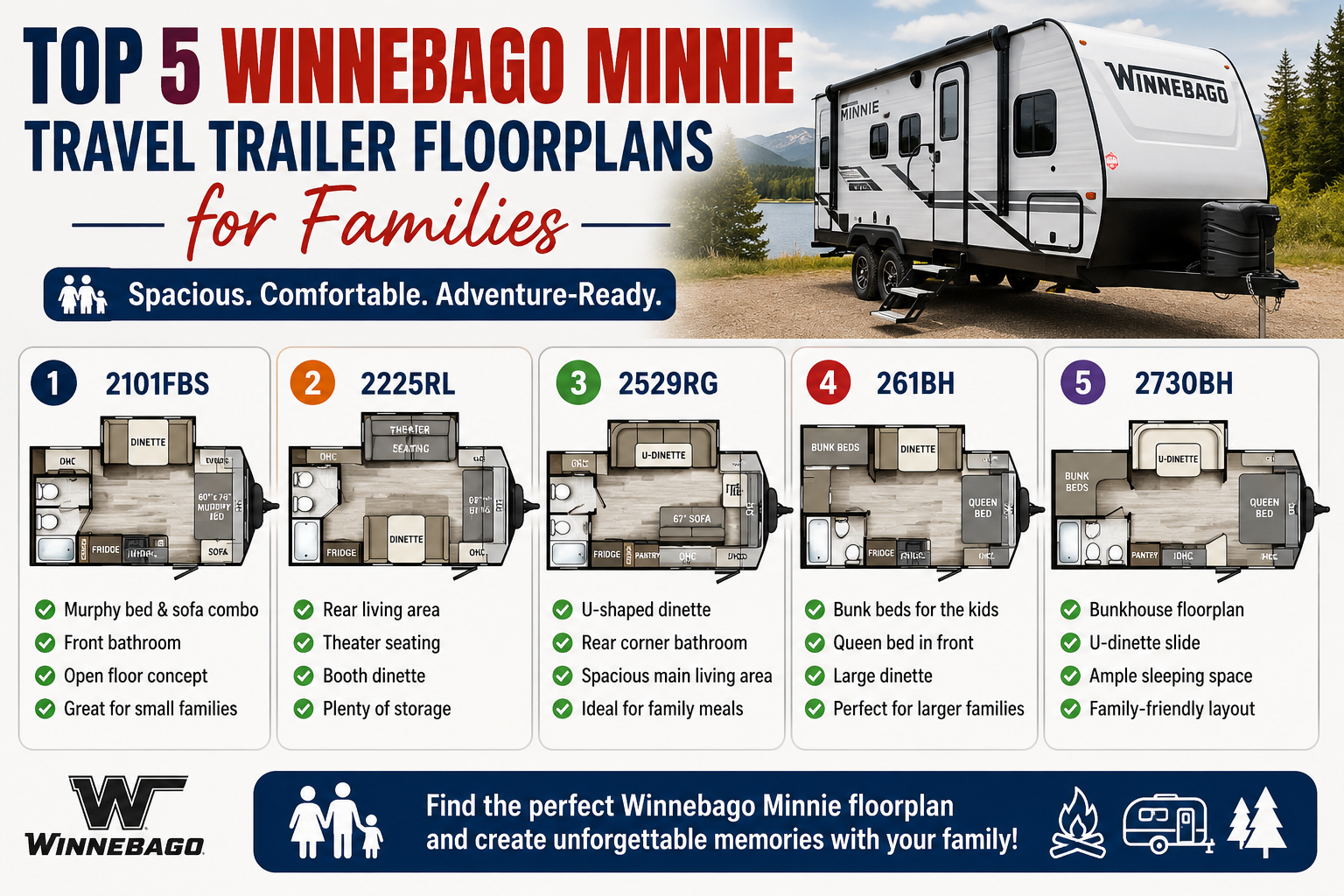

The Top 5 Winnebago Minnie Travel Trailer Floorplans for Families offer an appealing combination of comfortable living space, practical layouts, and family-friendly sleeping arrangements. The Minnie lineup is designed to provide a relatively easy-to-tow travel trailer while making efficient use of interior space. Current Minnie floorplans range from compact layouts to larger family models, giving travelers several ways to balance sleeping capacity, comfort, and towing needs.
For families, choosing the right floorplan is about more than the number of beds. A good layout should provide comfortable sleeping areas, enough seating for meals and rainy days, useful kitchen space, bathroom convenience, and storage for clothing and outdoor gear. The five layouts featured here stand out because they offer different solutions for families with varying space and travel requirements.
Why Winnebago Minnie Floorplans Work Well for Families
The Minnie is built around the idea of making a travel trailer feel useful without making it unnecessarily difficult to tow. Winnebago describes the current Minnie as an easy-to-pull travel trailer designed to maximize its compact footprint, while the lineup includes floorplans from roughly 26 feet to more than 32 feet long.
Family needs can change considerably depending on the number and ages of travelers. Parents may want a private sleeping area while children benefit from dedicated bunks. Other families may prefer a flexible layout where furniture can serve multiple purposes. The variety within the Minnie range makes it possible to choose a floorplan based on how your family actually travels rather than simply choosing the largest trailer available.
Winnebago Minnie 2801BHS
The 2801BHS is one of the strongest Minnie choices for larger families because it combines a front queen bed with a rear bunkhouse. Winnebago currently lists the layout at 32 feet 5 inches and gives it sleeping capacity for up to seven people on its current product page. The rear bunkhouse provides children with a dedicated sleeping zone while the front bedroom gives parents a more private space.
The layout also includes multiple seating arrangements in a slideout, which can make the central living area more comfortable when the family is spending time inside. Its larger size can provide a more spacious experience at the campground, although buyers should carefully consider tow-vehicle capacity, parking requirements, and campsite size before choosing this floorplan.
Winnebago Minnie 2301BHS
The 2301BHS offers a family-oriented bunkhouse design in a slightly shorter package. The current Minnie listing shows an exterior length of 29 feet 9 inches and sleeping capacity for up to six people. It places a front queen bed alongside a rear bunkhouse, creating separate sleeping areas that can be especially useful for parents traveling with children.
Another useful feature is the slideout seating arrangement located near the refrigerator. This helps open up the main living space and provides greater flexibility for family meals, relaxing, or spending time indoors. For families that want bunk beds without stepping up to the largest Minnie floorplan, the 2301BHS can be a compelling middle-ground option.
Winnebago Minnie 2326BH
The 2326BH is particularly interesting for families seeking substantial sleeping capacity in a shorter trailer. Winnebago lists this floorplan at 26 feet 8 inches and describes it as sleeping up to six people. It includes large rear bunk beds, a spacious kitchen, and a full bathroom, while the seating area can be configured with a sofa, U-shaped dinette, or theater seating.
Its shorter overall length may make it attractive to families who want a more manageable trailer while still having dedicated bunk sleeping. The combination of bunk beds, kitchen space, bathroom facilities, and flexible seating makes this layout worth considering for weekend trips and longer family adventures alike.
Winnebago Minnie 2529RG
The 2529RG takes a different approach to family camping by emphasizing living and kitchen space rather than a dedicated bunkhouse. The current Minnie lineup lists it at 29 feet 6 inches with sleeping capacity for up to five people. It features a front queen bed, a slideout containing a sofa or optional theater seating, and a rear galley.
This layout may suit families with older children or travelers who do not need permanent bunk beds. The rear galley arrangement can create a distinct kitchen zone, while the slideout helps increase usable living space. Families should consider how sleeping arrangements will work for everyone, particularly if multiple children need dedicated beds.
Winnebago Minnie 2327TB
The 2327TB is a flexible option for families who value adaptable sleeping arrangements. Winnebago describes it as a front twin-to-king convertible bed floorplan with multiple seating arrangements in a slideout and a rear bathroom. The current listing shows an exterior length of 27 feet 1 inch and sleeping capacity for four.
The convertible front sleeping area makes this layout particularly interesting for families whose needs may change from one trip to another. It can also appeal to couples who occasionally travel with children or guests. Because it sleeps fewer people than the bunkhouse models, it is best suited to smaller families rather than large groups requiring individual sleeping spaces.
Comparing the Best Minnie Family Floorplans
Choosing among these five layouts ultimately depends on your family’s size, sleeping preferences, towing setup, and camping style. The 2801BHS provides the most substantial family-oriented space of the group, while the 2301BHS delivers a bunkhouse arrangement in a somewhat shorter trailer. The 2326BH is especially attractive for families wanting bunk beds while keeping overall length relatively compact.
The 2529RG and 2327TB are better suited to families that prioritize flexible living arrangements over dedicated bunkhouses. Before purchasing, families should walk through their preferred trailer, test the sleeping spaces, examine storage, and consider how everyone will use the kitchen and bathroom. Floorplan diagrams can look spacious on paper, but real-world usability matters just as much.
What Families Should Consider Before Buying
Towing compatibility should be one of the first considerations when choosing a Minnie travel trailer. A trailer’s length, loaded weight, hitch weight, passengers, cargo, and other equipment all affect the towing equation. Buyers should compare the trailer’s specifications with the tow vehicle’s manufacturer-rated capacities rather than relying solely on a general assumption about what a vehicle can pull.
Daily usability is equally important. Think about where children will sleep, how much storage your family needs, whether everyone can comfortably sit inside during bad weather, and how easily you can access the bathroom and kitchen. Winnebago notes that specifications, features, materials, and pricing can change, so prospective buyers should confirm the exact configuration with a dealer before making a purchase.
Conclusion
The Top 5 Winnebago Minnie Travel Trailer Floorplans for Families provide several practical ways to enjoy family camping without automatically choosing the largest possible trailer. The 2801BHS and 2301BHS stand out for families that want dedicated bunkhouse sleeping, while the 2326BH offers a shorter family-friendly alternative with rear bunks. The 2529RG and 2327TB provide more flexible layouts for smaller families and travelers who have different sleeping priorities.
The best choice depends on how your family actually travels. Consider sleeping capacity, trailer length, living space, kitchen design, bathroom access, storage, and towing requirements before making a decision. A carefully selected Minnie floorplan can turn weekend escapes and extended road trips into comfortable family adventures while giving everyone a practical place to relax at the end of the day.
FAQs
Which Winnebago Minnie is best for a large family?
The 2801BHS is one of the strongest options for larger families because its current configuration sleeps up to seven and includes a rear bunkhouse.
Which Minnie floorplan has bunk beds?
The 2301BHS, 2801BHS, and 2326BH are family-oriented Minnie layouts that include dedicated bunk sleeping areas.
Which Minnie is easiest to tow?
A smaller Minnie is generally easier to manage than a longer, heavier trailer, but actual towability depends on the loaded trailer and the specific tow vehicle. Always compare manufacturer-rated capacities before purchasing.
How many people can the Minnie 2326BH sleep?
Winnebago currently lists the 2326BH as sleeping up to six people. It is 26 feet 8 inches long and includes rear bunk beds.
Is the 2301BHS good for families with children?
Yes. Its front queen bed and rear bunkhouse create separate sleeping areas, while the slideout seating helps provide additional living space. Winnebago currently lists sleeping capacity for up to six.
Is the Minnie 2529RG suitable for a family?
The 2529RG can work well for a smaller family that does not require a dedicated bunkhouse. Its current layout sleeps up to five and includes a front queen bed plus flexible slideout seating.
What should I check before buying a Minnie travel trailer?
Check the exact floorplan, sleeping capacity, loaded weight, hitch weight, storage, bathroom arrangement, kitchen space, and your tow vehicle’s rated capacity. Also confirm current specifications and pricing with a Winnebago dealer.
Are Winnebago Minnie specifications subject to change?
Yes. Winnebago states that pricing, components, standard features, specifications, materials, and other details can change without notice. Buyers should verify the final configuration before purchasing.



[…] and provide useful reminders about payments, documentation, transportation, and other important travel details. Excellent service can generate referrals and repeat bookings, helping you build a sustainable […]
[…] Manufacturing builds several RV families, but its travel trailers are particularly recognized for sturdy construction and four-season […]