



















































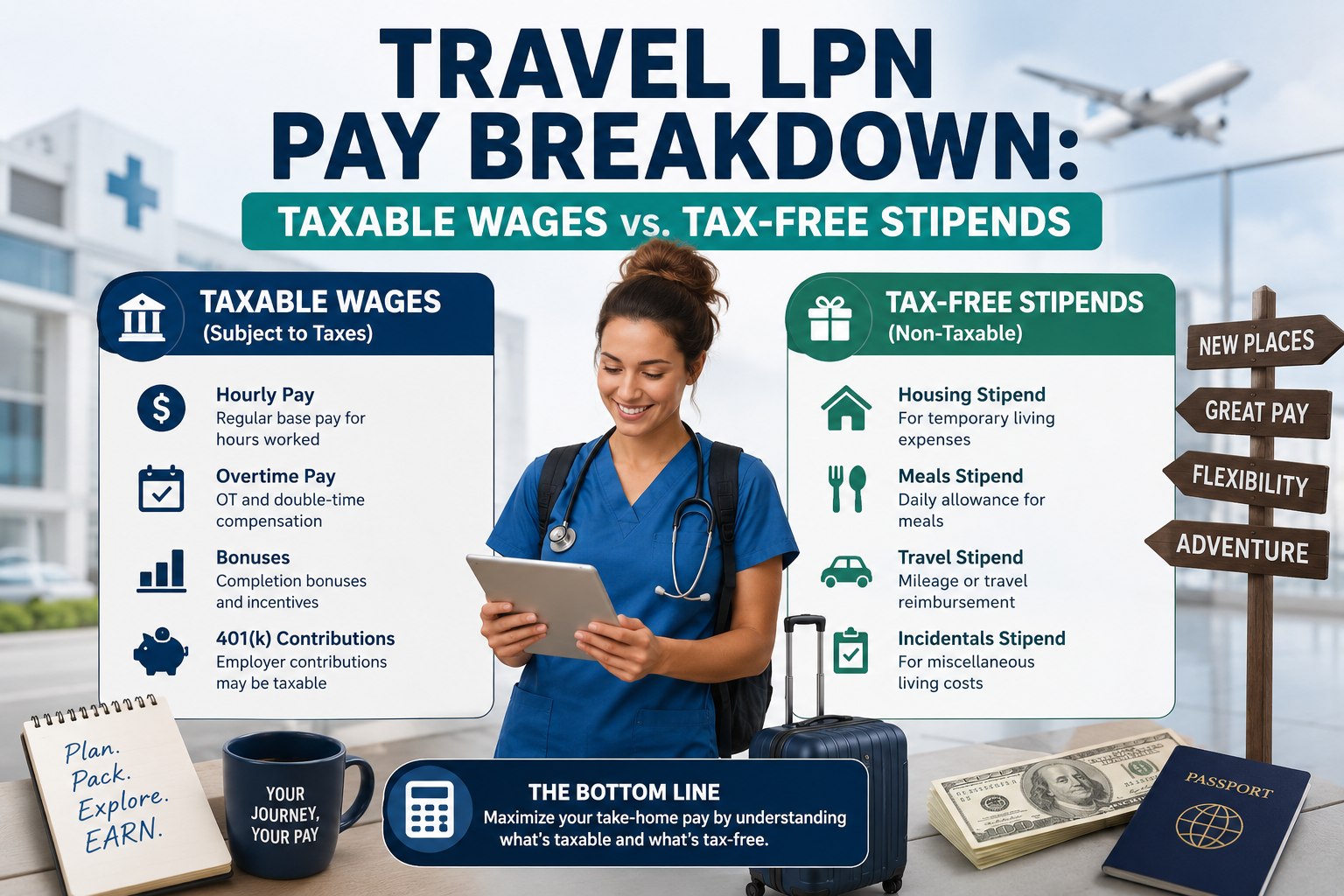

Travel LPN Pay Breakdown: Taxable Wages vs. Tax-Free Stipends is an important topic for licensed practical nurses considering temporary assignments in different states. A travel LPN package can look much larger than a traditional staff-nurse paycheck because compensation may combine an hourly taxable wage with housing, meals, and travel-related allowances. However, the amount advertised as a total weekly package is not necessarily the amount that will appear as taxable wages on your paycheck.
Understanding how each part of a compensation package works can help you compare assignments more accurately. Tax treatment depends on the structure of the payment, your employment arrangement, your tax home, and whether the assignment qualifies as temporary under applicable tax rules. The information below focuses primarily on U.S. federal tax principles, so nurses should consult a qualified tax professional about their individual circumstances.
Understanding Travel LPN Compensation
Travel LPN compensation usually has several components. The taxable portion commonly includes the regular hourly wage and potentially overtime or other taxable compensation. The remaining value may include employer-provided or reimbursed travel expenses, housing assistance, meals and incidental expense allowances, or other payments connected to a temporary assignment.
The important point is that a larger weekly package does not automatically mean every dollar is tax-free. The Internal Revenue Service explains that certain travel expenses can be excluded from wages when they meet the requirements for an accountable plan and the employee is traveling away from their tax home on a qualifying temporary assignment.
Taxable Wages for Travel LPNs
Taxable wages are the portion of compensation generally reported as wages on your Form W-2. Your base hourly rate is normally part of this amount, along with taxable overtime, bonuses, and other compensation. Federal income tax, Social Security, and Medicare taxes generally apply to taxable wages.
The taxable hourly rate is important when comparing two travel assignments. For example, one agency might advertise a relatively high hourly rate with smaller allowances, while another may offer a lower taxable rate combined with qualifying travel-related reimbursements. Looking only at the weekly package can make the comparison misleading, so examine the complete pay structure before accepting an assignment.
Understanding Tax-Free Stipends
Travel nurses often hear the term “tax-free stipend,” but the phrase can create confusion. A payment is not automatically tax-free simply because an agency labels it a stipend. Federal tax rules focus on whether the payment qualifies under the applicable travel-expense rules and whether the required conditions are satisfied.
Under an accountable plan, qualifying business travel reimbursements can generally be excluded from an employee’s wages when the expenses have a business connection, are adequately substantiated, and excess amounts are returned within a reasonable period. Payments that fail these requirements can become taxable compensation.
Housing Stipends and Housing Assistance
Housing is often one of the largest components of a travel LPN compensation package. An agency may provide company-arranged housing or offer a housing allowance intended to help cover temporary lodging near the assignment. The tax treatment depends on whether the payment satisfies the requirements for excluding qualifying travel expenses from wages.
A nurse should not assume that receiving money for housing automatically makes that money tax-free. The assignment must meet the relevant requirements, including the rules surrounding a tax home and temporary work location. If an assignment becomes indefinite, the tax treatment can change, and living expenses paid by an employer may have to be included in wages.
Meals and Incidental Expense Stipends
Meals and incidental expenses can also form part of a travel LPN package. These allowances are intended to help cover costs associated with being away from the nurse’s tax home for qualifying business travel. Federal per diem rules may provide a framework for certain reimbursements when the employer’s plan meets the required conditions.
Documentation remains important. The IRS states that an accountable-plan arrangement generally requires adequate accounting for the time, place, and business purpose of qualifying expenses. When requirements are not met, the payment may instead be treated as taxable wages.
Travel Reimbursements
Travel reimbursement may cover certain costs associated with reaching a temporary assignment. Depending on the arrangement, an agency may reimburse eligible transportation expenses or provide an allowance. Qualifying business travel expenses can potentially be excluded from wages when the applicable accountable-plan requirements are satisfied.
It is important to distinguish reimbursement from additional salary. If an employer simply relabels part of normal compensation as a travel allowance without meeting the requirements of an accountable plan, the payment may be taxable. The IRS specifically notes that amounts paid under a nonaccountable plan are generally treated as wages and are subject to applicable payroll taxes.
Why Your Tax Home Matters
Your tax home is a central concept in determining whether travel expenses qualify for favorable tax treatment. Generally, the IRS considers your tax home to be the general area of your main place of business or work. Having a personal residence somewhere does not automatically establish that location as your tax home for federal travel-tax purposes.
This distinction is especially important for travel LPNs who regularly move between assignments. A nurse may need to demonstrate that they maintain a legitimate tax home and are actually traveling away from it for temporary work. If a person has no qualifying tax home and is considered an itinerant, the tax treatment of travel expenses can be significantly different.
The One-Year Rule for Temporary Assignments
Federal tax rules generally distinguish between temporary and indefinite assignments. The IRS states that a temporary assignment in one location is generally one that is realistically expected to last one year or less. An assignment expected to last more than one year is generally considered indefinite, even if the nurse ultimately works there for less time.
Circumstances can also change during an assignment. If a nurse initially expects an assignment to last less than a year but later learns that the assignment will extend beyond that period, the tax treatment can change from that point forward. This is why nurses should keep records of contracts, extensions, and changes in assignment expectations.
Comparing Two Travel LPN Pay Packages
Suppose one travel assignment offers a higher taxable hourly rate but smaller allowances, while another offers a lower taxable rate and larger qualifying travel reimbursements. The second package could potentially provide more take-home pay, but the comparison should not be based solely on the advertised weekly amount.
Look at the taxable hourly rate, expected weekly hours, overtime structure, housing arrangements, meals and incidental allowances, travel reimbursement, insurance costs, retirement benefits, and any agency fees. Also consider your actual housing costs and the tax consequences of the arrangement. A lower advertised package may sometimes be more valuable when the compensation structure better matches your needs.
How to Read a Travel LPN Pay Package
Before accepting an assignment, ask the staffing agency for a written breakdown of every compensation component. You should know your taxable hourly rate, overtime rate, housing allowance or housing arrangement, meals and incidental allowance, travel reimbursement, guaranteed hours, and any other compensation.
It is also useful to ask whether each allowance is paid under an accountable plan and what documentation the agency requires. A reputable agency should be able to explain its compensation structure clearly, but the agency’s description does not replace independent tax advice. Your personal circumstances can affect whether a payment is actually tax-free.
Common Mistakes Travel LPNs Should Avoid
One common mistake is assuming that every stipend advertised by a staffing agency is automatically tax-free. Another is accepting a high weekly package without examining the taxable wage portion. These misunderstandings can lead to unrealistic expectations about take-home pay and potentially unexpected tax obligations.
Another mistake is ignoring changes to an assignment. Extensions, repeated assignments in the same location, or a change in expected duration can affect whether an assignment remains temporary. Keeping copies of contracts, housing records, travel documentation, and pay statements can make it easier to demonstrate the facts of your situation if questions arise.
Conclusion
Understanding the difference between taxable wages and potentially tax-free travel reimbursements is essential when evaluating a travel LPN compensation package. Your taxable hourly wage is generally subject to payroll and income taxes, while qualifying travel-related reimbursements may receive different treatment when the requirements of an accountable plan and temporary travel rules are satisfied.
The most important lesson is to look beyond the headline weekly package. Consider the taxable wage, allowances, housing, travel reimbursement, assignment length, and your tax-home situation together. Because tax rules can depend on individual circumstances, a qualified tax professional familiar with travel healthcare workers can help you determine how your specific arrangement should be handled.
FAQs
Are travel LPN stipends always tax-free?
No. A stipend is not automatically tax-free because of its name. Its treatment depends on applicable tax rules, the nature of the expense, the plan used by the employer, and the nurse’s circumstances.
What part of travel LPN pay is usually taxable?
The regular hourly wage, overtime, bonuses, and other compensation are generally taxable. Certain qualifying travel reimbursements may be excluded when the applicable requirements are satisfied.
Why is a tax home important for travel nurses?
A qualifying tax home can be important when determining whether you are genuinely traveling away from home for temporary employment. The IRS uses specific rules to determine tax-home status.
What happens if my travel assignment lasts more than one year?
An assignment expected to last more than one year is generally considered indefinite for federal travel-tax purposes. In that situation, the assignment location can become your tax home, changing the treatment of related travel expenses.
Can housing money be taxable?
It can be, depending on the circumstances. Housing payments connected with an indefinite assignment or payments that do not meet applicable accountable-plan requirements may be included in taxable wages.
What is an accountable plan?
An accountable plan is an employer reimbursement arrangement that generally requires a business connection, appropriate substantiation of expenses, and the return of excess amounts within a reasonable period.
Should I compare travel LPN jobs by weekly pay?
You should compare the complete compensation package rather than only the weekly headline amount. Consider taxable wages, qualifying allowances, housing, travel reimbursement, benefits, guaranteed hours, and your expected living costs.
Should travel LPNs talk to a tax professional?
Yes. Tax-home status and stipend treatment can depend on individual facts. A qualified tax professional can review your specific circumstances and explain how federal and applicable state tax rules may affect your assignment.



[…] in neonatal intensive care units. These nurses care for newborns who may need specialised treatment because of premature birth, respiratory difficulties, congenital conditions, infections, or other […]
[…] Someone encountering it in a profile should not automatically interpret it as a precise identity statement without additional context. Online terminology often depends on individual intent, and unusual […]